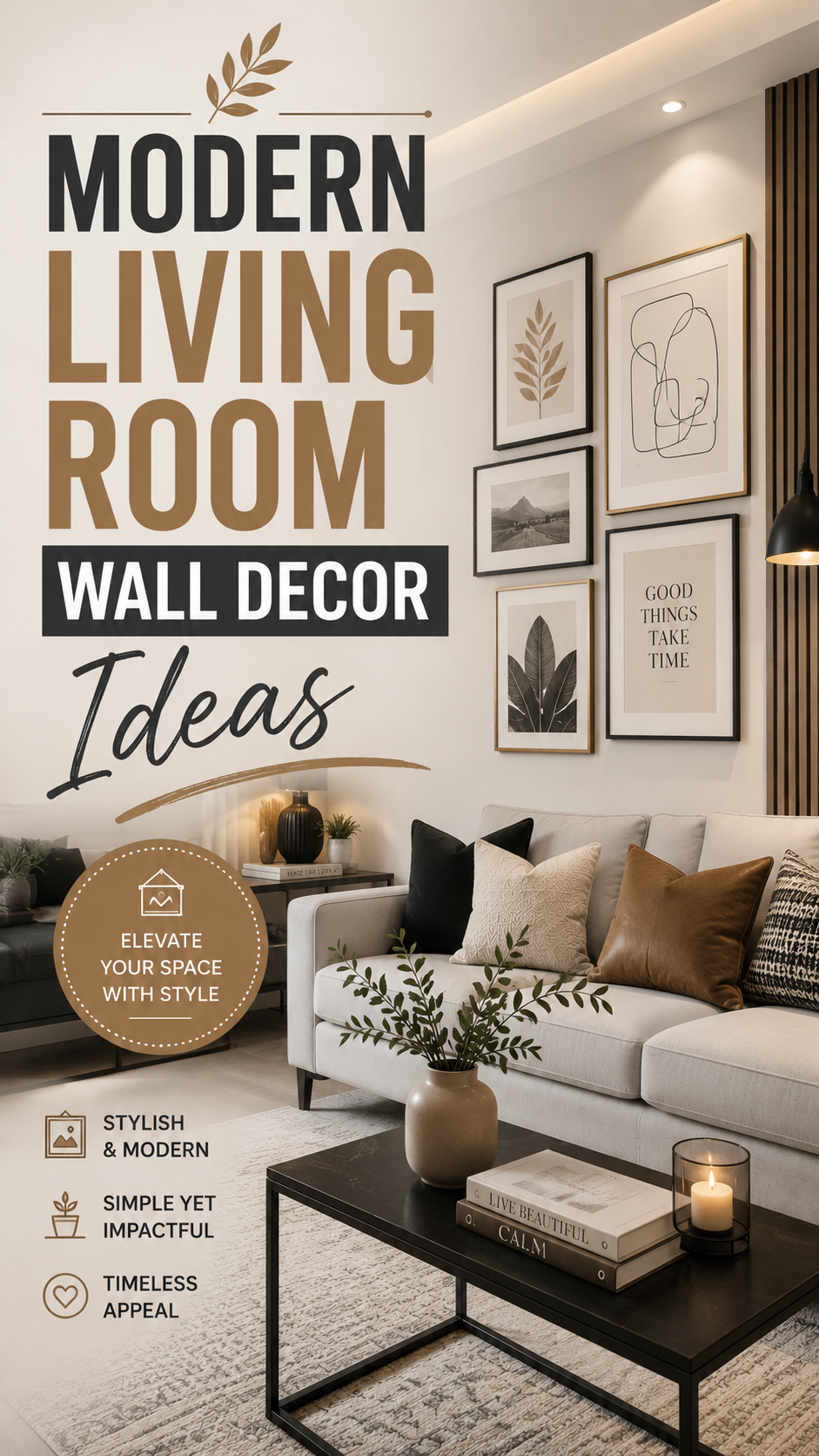
Why does every wall gallery on Pinterest start to look the same after a while?
Because most people copy the layout, not the thinking behind it. Modern wall decor isn’t about following a formula. It’s about understanding a few core rules of scale, spacing, and contrast, then applying them to whatever you actually love.
A blank wall is one of the easiest things to fix in a living room, and one of the most overlooked. You don’t need to gut the whole space. You need the right pieces, hung the right way, in the right spots.
Here’s exactly how to do that. 🖼️
What You’ll Need
- 1 large statement art piece or mirror
- 3 to 5 smaller framed prints for a gallery wall
- A mix of frame finishes (black, wood, or brushed brass)
- Floating wood shelves
- A sculptural wall clock or abstract wall object
- Woven wall hanging or macrame piece
- Picture hanging hardware (nails, hooks, or a wall hanging strip system)
- Level and measuring tape
- LED picture lights or a plug-in wall sconce (optional)
- Removable adhesive strips (for renters)
Tools You Might Need
- Measuring tape
- Level
- Stud finder
- Hammer or drill
- Pencil for marking placement
- Painter’s tape (for planning layouts before hanging)
Pro Styling Tips
1. Hang art at eye level, not ceiling height. The center of your piece should sit around 57 to 60 inches from the floor. Most people hang art too high.
2. Scale to your wall, not your art collection. A large empty wall needs one big piece more than it needs five small ones. Fill space with size before you fill it with quantity.
3. Mix mediums, not just frames. Combine a framed print with a mirror, a shelf, or a textured wall hanging. Variety in material reads as more intentional than all-matching frames.
4. Plan your layout on the floor first. Lay everything out on the ground in your intended arrangement before you hammer a single nail.
5. Leave 2 to 3 inches between gallery pieces. Too much spacing looks disconnected. Too little looks cluttered. Two to three inches keeps it tight but breathable.
Substitutions and Variations
| Element | Budget Swap | Small Space Version | Large Space Version |
|---|---|---|---|
| Statement art | Printable digital art framed at home | One medium piece above a console | Oversized canvas above the sofa |
| Gallery wall | Mix of thrifted frames, spray-painted to match | 3-piece mini gallery | 7 to 9 piece full gallery wall |
| Mirror | Simple round mirror from a discount store | Small round or oval mirror | Full-length or oversized arched mirror |
| Shelving | Single floating shelf | One shelf styled with 2 to 3 items | Multiple shelves in a staggered layout |
| Wall hanging | DIY macrame kit | Small woven piece near a reading chair | Large-scale fiber art as a focal point |
Style variations to try:
- Modern minimalist: One large abstract piece, black frame, nothing else on that wall.
- Modern eclectic: Mix mediums freely, combine a mirror, art, and a shelf on one wall.
- Modern warm: Add wood-framed pieces and a woven hanging for texture against clean lines.
Make Ahead / Prep Tips
- Measure your wall’s full width and height before shopping for art.
- Trace your frames onto kraft paper and tape the outlines to the wall to preview placement.
- Order large statement pieces first since they often have longer shipping times.
- Decide on your hardware (nails vs. a wall strip system) based on wall type before you start.
- If renting, test adhesive strips on a small hidden section of wall first.
Step-by-Step: How to Get the Look
Step 1: Choose Your Focal Wall
Pick the wall your eye lands on first when entering the room. That’s usually behind the sofa or across from the entry.
Step 2: Decide on One Statement or a Gallery
Choose one large piece for a clean, modern look, or a grouped gallery for more visual interest.
Step 3: Map It Out on Paper
Trace each frame size on kraft paper, cut it out, and tape the shapes to the wall to preview the layout.
Step 4: Mark Your Hanging Points
Use a level and pencil to mark exact nail or hook positions based on your paper templates.
Step 5: Hang the Largest Piece First
If doing a gallery, start with your biggest piece as the anchor, then build outward.
Step 6: Add Supporting Pieces
Fill in smaller frames, mirrors, or shelves around your anchor piece, keeping 2 to 3 inches of spacing.
Step 7: Style Any Shelves
Add 2 to 3 items per shelf, mixing height and texture, like a small vase, a stack of books, and one framed print.
Step 8: Step Back and Adjust
View the wall from across the room and adjust anything that feels off-center or unbalanced.
Maintenance and Upkeep
- Dust frames and shelves weekly with a dry microfiber cloth.
- Check hanging hardware every few months, especially on heavier mirrors or shelves.
- Rotate smaller art pieces seasonally to keep the wall feeling fresh without buying new pieces.
- Clean glass-covered frames with a glass cleaner, never directly on canvas or textured pieces.
- Reapply adhesive strips if using them, since they lose grip over time in humid rooms.
FAQ
How high should I hang art above my sofa? Leave about 6 to 8 inches between the top of the sofa and the bottom of the frame.
What size art works best for a large empty wall? As a rule, your art should cover roughly two-thirds of the furniture width below it.
Can I mix frame colors on one wall? Yes. Two to three finishes, like black and wood, tends to look more intentional than one single finish across everything.
Do I need professional art for this to look modern? No. Printable digital art, framed well and hung correctly, can look just as polished as expensive originals.
What’s the biggest mistake people make with wall decor? Hanging everything too high. Eye level almost always looks better than ceiling height.
Wrapping Up
Modern wall decor comes down to a few repeatable rules: right height, right scale, and a mix of textures that feels put together instead of matched. Once you get those three right, almost any combination of pieces will work.
Start with one wall and one rule, like fixing your hanging height, and build from there.
Have you redone a wall in your living room recently? Share what worked, or what you’re still trying to figure out, in the comments.