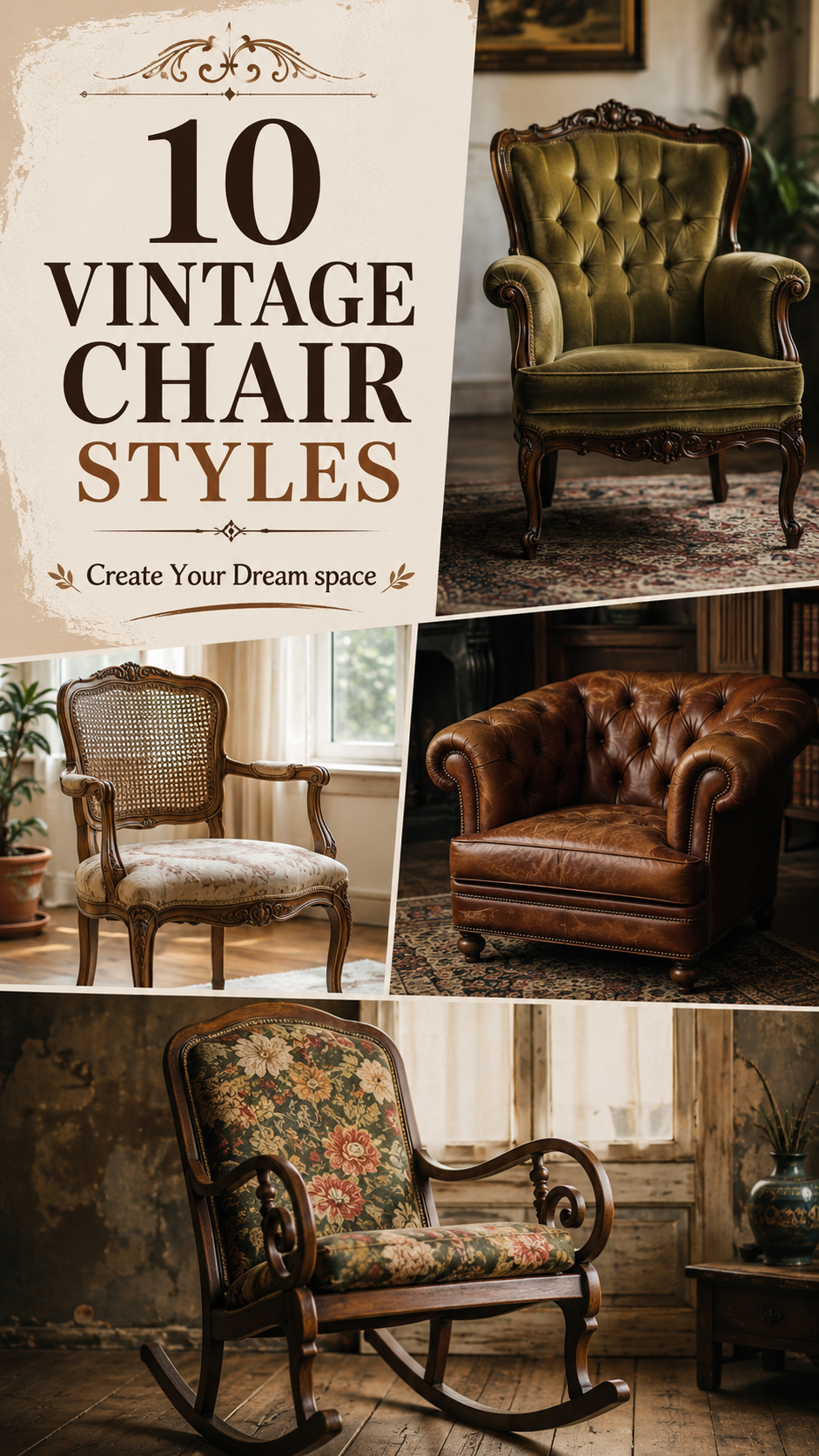
A chair is never just a chair. Sit in a Windsor and you’re borrowing a shape that’s been in kitchens since the 1700s. Sit in an Eames shell and you’re sitting in a piece of furniture history that changed how homes looked forever.
That’s the magic of vintage seating. One good chair can carry an entire room’s personality.
Here’s your guide to 10 vintage chair styles worth knowing, plus exactly how to style them so they look intentional, not thrifted-and-forgotten.
What You’ll Need
- One or more vintage-style chairs (thrifted, inherited, or new reproductions)
- Fabric or leather for reupholstering (if the seat needs a refresh)
- Wood conditioner or furniture wax
- A throw blanket or textured cushion
- A small side table or plant stand to pair with the chair
- Picture rail hooks or wall art to anchor the space above it
- A rug to define the seating area
- Soft, warm-toned lighting (a floor lamp or table lamp nearby)
The 10 Styles, at a Glance
| Style | Era | Signature Look |
|---|---|---|
| Windsor | 1700s | Spindle back, solid wood seat |
| Bentwood (Thonet) | 1850s | Curved wood, cafe-style |
| Chippendale | 1750s | Carved wood, cabriole legs |
| Victorian Balloon-Back | 1830s–1900s | Rounded, curved backrest |
| Wingback | 1600s | Tall, side “wings,” upholstered |
| French Provincial | 1700s | Carved detail, cane or fabric seat |
| Art Deco | 1920s–30s | Geometric lines, bold upholstery |
| Shaker | 1800s | Simple, straight, ladder-back |
| Eames Molded Shell | 1950s | Curved plastic or fiberglass shell |
| Rattan Peacock | 1900s–1970s | Fan-shaped woven back |
Windsor Chairs
Spindle backs, a solid wood seat, and legs that splay slightly outward. Originally built for English gardens and taverns, they now work anywhere from a farmhouse kitchen table to a reading nook.
Bentwood Chairs
Michael Thonet bent steamed wood into curves in the 1850s, and the result became the definition of a classic cafe chair. Lightweight, stackable, and honestly still hard to improve on.
Chippendale Chairs
Named after 18th century furniture maker Thomas Chippendale. Look for carved wood details and curved cabriole legs. These bring instant formality to a dining room.
Victorian Balloon-Back Chairs
That rounded, almost heart-shaped backrest is the giveaway. Pair one in a bedroom corner with a small vanity for an old-world touch that doesn’t feel costume-y.
Wingback Chairs
The tall “wings” on either side of the headrest were originally designed to block drafts and trap fireplace heat. Function became fashion, and now they’re a living room staple.
French Provincial Chairs
Softer and more rustic than full French antiques. Carved wood frames, cane or upholstered seats, and a slightly worn, lived-in charm.
Art Deco Chairs
Bold geometric shapes, often with velvet or leather upholstery. These make a statement in a home office or a moody reading corner.
Shaker Chairs
Straight lines, ladder backs, woven or wood seats. Built with almost no ornamentation because the Shaker community believed decoration was wasteful. Somehow that restraint still looks modern today.
Eames Molded Shell Chairs
Charles and Ray Eames designed these in the late 1940s and 50s using molded plastic and fiberglass. One of the first mass-produced plastic chairs, and still one of the most recognizable pieces in furniture history.
Rattan Peacock Chairs
That dramatic fan-shaped woven back has roots in the Philippines and became a 1970s bohemian icon. One chair in a sunroom corner does more decorating work than an entire Pinterest board.
Pro Styling Tips
- Mix eras on purpose. A Windsor chair next to a mid-century sofa reads as curated. Matching everything reads as a showroom.
- Let one chair be the anchor. Pick a single statement piece per room instead of scattering vintage finds everywhere.
- Reupholster in a modern fabric. An old wingback frame with a bold contemporary print feels fresh instead of dated.
- Check the joints before you fall in love. Wobbly legs and cracked frames are fixable, but know what you’re getting into.
- Give it breathing room. Vintage chairs shine when there’s space around them, not crowded next to three other pieces.
Tools You’ll Need (For Any DIY Touch-Ups)
- Screwdriver set
- Wood glue
- Sandpaper (medium and fine grit)
- Staple gun (for reupholstering)
- Fabric scissors
- Furniture wax or polish
- Soft cloths
Substitutions and Variations
Budget swaps:
- Can’t find real Thonet bentwood? Look for reproduction cafe chairs at secondhand shops.
- Skip full reupholstery and just add a seat cushion instead.
Small space version:
- One accent chair in a corner nook does the job. Skip the pair.
Large space version:
- Two matching (or complementary) chairs flanking a fireplace or window create symmetry without feeling stiff.
Style swaps:
- Boho: Rattan peacock or French provincial with a woven throw
- Farmhouse: Windsor or Shaker in natural wood
- Moody/eclectic: Art Deco or wingback in deep jewel-tone fabric
- Minimalist: Eames shell in white or black
Make Ahead / Prep Tips
- Measure your space before you shop. A chair that looks small in a store can swallow a room.
- If reupholstering, order fabric at least two weeks ahead. Good upholstery fabric often has to be shipped.
- Test wood conditioner or wax on a hidden spot first.
- Photograph the room from a few angles before you buy, so you can picture the chair’s scale in context later.
Step-by-Step: How to Bring the Look Together
- Pick your anchor chair. Choose the style that matches the room’s existing vibe.
- Assess the condition. Check joints, fabric, and wood finish.
- Decide: refresh or restore. A quick wax might be all it needs. A full reupholster is a bigger project.
- Choose a complementary fabric or finish if you’re updating it.
- Place the chair with breathing room on all sides.
- Add a small side table or plant next to it for balance.
- Layer in a throw or cushion for texture.
- Anchor with a rug underneath or nearby to define the space.
- Add warm lighting close by so the chair becomes a spot people actually want to sit in.
- Step back and edit. Remove anything that feels crowded.
Maintenance and Upkeep
- Dust wood frames weekly with a soft, dry cloth.
- Condition wood every few months to prevent drying and cracking.
- Vacuum upholstered seats with a brush attachment to keep fabric fibers clean.
- Rotate cushions if the chair gets regular use, so wear is even.
- Keep chairs out of direct sunlight when possible. UV rays fade fabric and dry out wood fast.
- Tighten screws and joints once a year, especially on chairs that get daily use.
FAQ
How do I know if a chair is real vintage or just made to look old? Check the construction. True vintage pieces often use dovetail joints, solid wood, and hand-finished details. Reproductions tend to use particle board or machine-uniform joints.
Is it worth restoring a damaged vintage chair? If the frame is solid, yes. Frames are the expensive part to replace. Fabric and finish are the easy fixes.
Can I mix multiple vintage styles in one room? Yes, and it usually looks better than matching everything. Just keep a common thread, like wood tone or color palette, to tie them together.
Where’s the best place to find real vintage chairs? Estate sales, antique markets, and secondhand shops tend to have better finds and prices than general vintage-labeled retail.
Do vintage chairs work in modern homes? Absolutely. One vintage piece against clean, modern lines often looks more interesting than an entire room of new furniture.
Wrapping Up
A single vintage chair can shift how a whole room feels. It adds a story that brand-new furniture just can’t fake.
Start with one piece. See how it changes the space. Then decide if you want to build from there.
Which style caught your eye? Drop a comment and let me know which chair you’re hunting for next.